
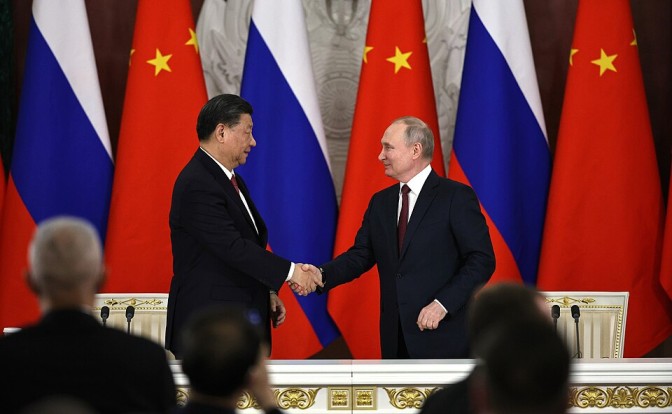
In a significant diplomatic development, Chinese President Xi Jinping and Russian President Vladimir Putin have agreed to extend the China-Russia Treaty of Good-Neighborliness and Friendly Cooperation. This decision, reached during talks in Beijing, underscores the commitment of both nations to enhance political mutual trust, strategic coordination, and practical cooperation amid escalating global uncertainties. The two leaders’ meeting culminated in the signing of a joint statement aimed at bolstering comprehensive strategic coordination and deepening their partnership, while also witnessing the signing of 20 cooperation documents across diverse sectors such as economy, trade, education, and science and technology.
As part of their discussions, Xi and Putin issued a joint statement advocating for a multipolar world and new international relations, reaching agreements on 20 additional areas of cooperation. Xi highlighted Putin’s 25th visit to China since 2000, reflecting the robust and unique ties between the two countries. This year marks both the 30th anniversary of their strategic partnership and the 25th anniversary of the treaty’s original signing. Xi emphasized the treaty’s principles of non-alliance and nonconfrontation, noting the countries’ contributions to international fairness and justice.
Xi and Putin are committed to building on previous achievements and firmly supporting each other’s core interests, maintaining strategic communication, and reinforcing political mutual trust. Their cooperation has yielded positive results, with bilateral trade surpassing $200 billion annually for the past three years. Xi urged further alignment of China’s Five-Year Plan and Russia’s development strategy to enhance mutually beneficial cooperation, serving the development goals of both nations. As permanent United Nations Security Council members, both countries aim to uphold international law and oppose unilateralism and any attempts to reverse historical outcomes.
Putin expressed confidence in the future of Russia-China relations, highlighting their unprecedented level of cooperation. He stressed the self-sufficient nature of their partnership, which he believes serves as a model for international relations. Both countries are committed to upholding international law and collaborating within frameworks like the Shanghai Cooperation Organization and BRICS to tackle global challenges. During their talks, Xi and Putin exchanged views on pressing international issues, including the Middle East situation, advocating for an end to hostilities and emphasizing the importance of continued negotiations.
To strengthen bilateral ties, China announced the extension of its visa-free policy for Russia until the end of 2027, with Russia reciprocating for Chinese citizens. Xi underscored the need to focus on national development goals and leverage established cooperation mechanisms to strengthen ties in trade, energy, transportation, and technological innovation. Efforts will also be made to foster exchanges in education, culture, tourism, and sports, consolidating public support for the enduring friendship between the two nations. The day concluded with a welcoming banquet hosted by Xi for Putin at the Great Hall of the People.