
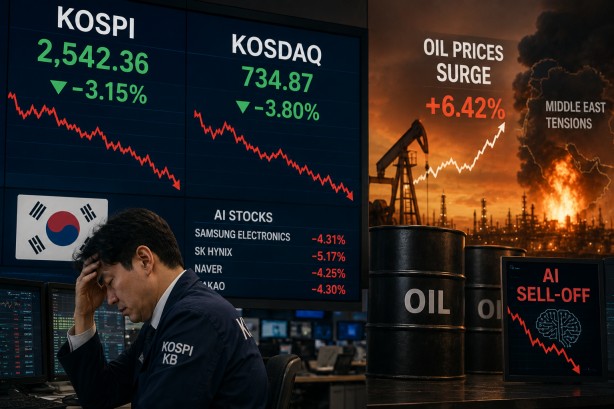
Monday saw mixed performances across Asian markets, with most indices closing higher despite a dramatic downturn in South Korea’s Kospi index, which plummeted nearly 5%. This sharp decline was largely driven by a significant sell-off in artificial intelligence-related stocks, as investors expressed growing concern about the sector’s valuation levels. Major technology companies bore the brunt of this sell-off, with Samsung Electronics and chipmaker SK Hynix experiencing losses of 4.4% and 3.3%, respectively.
In contrast, other Asian markets showed resilience. Hong Kong’s Hang Seng index climbed 2.1%, while China’s Shanghai Composite saw a 1.2% increase. Taiwan’s stock market remained relatively stable, bolstered by a 2% rise in Taiwan Semiconductor Manufacturing Co. Meanwhile, Australia’s benchmark index saw modest gains, though India’s Sensex dipped 0.9%.
The technology sector globally has been under scrutiny as investors reassess the massive investments in artificial intelligence, amid fears of a potential market bubble. The competitive landscape intensified following the introduction of the Kimi K3, an open-source AI model from Beijing-based Moonshot AI, further unsettling investor sentiment in the rapidly evolving AI sector.
Adding to the financial market tensions, oil prices surged amid escalating geopolitical concerns. The price of Brent crude jumped 2.6% to $90.40 per barrel, while U.S. crude rose 2.2% to $83.58 per barrel. These increases were driven by rising tensions between the United States and Iran, which sparked fears of broader disruptions in the Middle East, especially with the significant slowdown of tanker traffic through the Strait of Hormuz, a critical channel for global energy exports.
On Wall Street, the previous week ended on a downbeat note, with all major indices, including the S&P 500, Dow Jones Industrial Average, and Nasdaq, closing in negative territory. Chip stocks were particularly hard hit, as shares of Nvidia, Broadcom, and AMD all experienced declines, reflecting the broader apprehensions surrounding the tech sector and its future trajectory.