
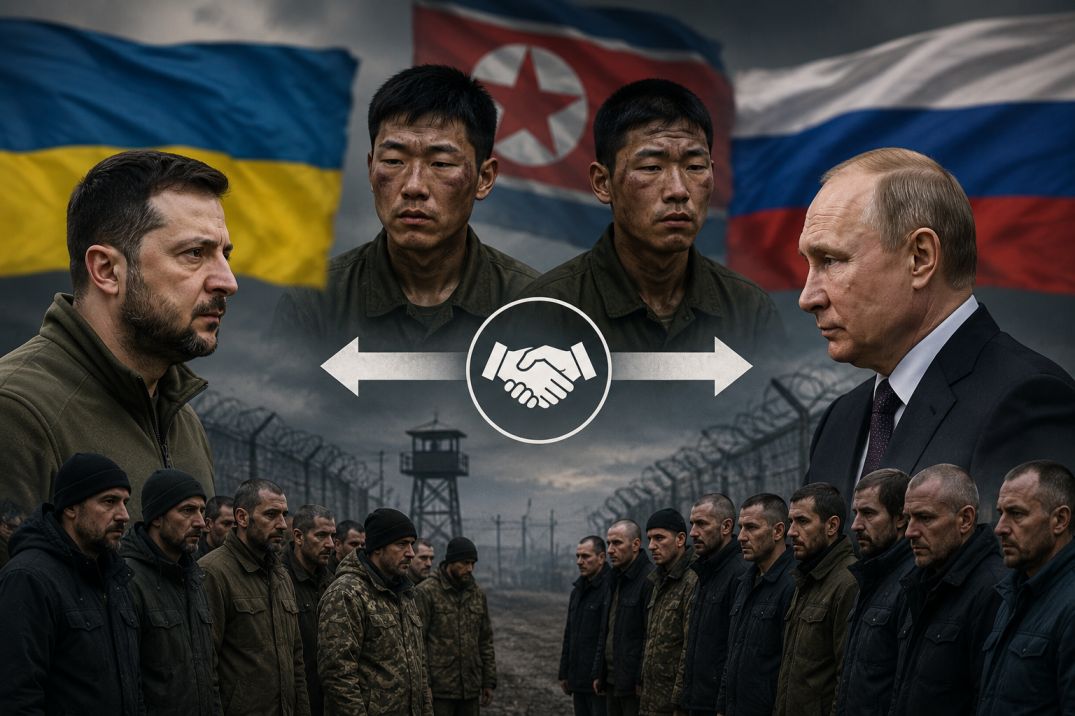
In a surprising development, Russia has reportedly suggested an exchange involving thousands of Ukrainian prisoners of war for two North Korean soldiers captured by Ukraine. This proposal, shared during Ukrainian Foreign Minister Andrii Sybiha’s visit to South Korea, could potentially complicate the ongoing discussions about the future of the North Korean prisoners. These soldiers have expressed a wish to resettle in South Korea, and diplomatic sources have raised doubts about Moscow making an offer of such scale.
The issue came to light during Sybiha’s meetings in Seoul with South Korean Foreign Minister Cho Hyun and during talks at the Asan Institute for Policy Studies. Reports indicate that Sybiha mentioned Russia’s proposal to return the North Korean soldiers to Pyongyang in exchange for the release of Ukrainian detainees held by Russia, not as a formal negotiation but to highlight the complex political decisions facing Kyiv. This situation underscores Ukraine’s challenge of balancing its humanitarian concerns with efforts to secure the release of its citizens.
South Korea has consistently stated its readiness to accept the two North Korean soldiers should they choose to relocate voluntarily, as it considers North Koreans citizens under its constitution. Ukrainian authorities have also made it clear they do not intend to forcibly repatriate the prisoners against their wishes, although no definitive resolution has been reached. This ongoing situation remains a sensitive topic involving humanitarian obligations and the potential for prisoner exchanges.
In addition to the prisoner dilemma, discussions between South Korea and Ukraine have widened to explore South Korea’s involvement in Ukraine’s postwar reconstruction. Ukraine is interested in South Korea’s assistance in rebuilding critical infrastructure, energy facilities, and other essential sectors following the conflict. Nevertheless, South Korea maintains that humanitarian issues regarding the prisoners of war are distinct from broader reconstruction cooperation or other forms of support.
The fate of the two North Korean soldiers, captured in Russia’s Kursk region in January 2025, remains uncertain. As the first known instance of North Korean troops being taken alive after their deployment to support Russia’s military operations, their case has become a focal point of international diplomatic discussions. These discussions are governed by international law and humanitarian principles, reflecting broader regional security concerns.